
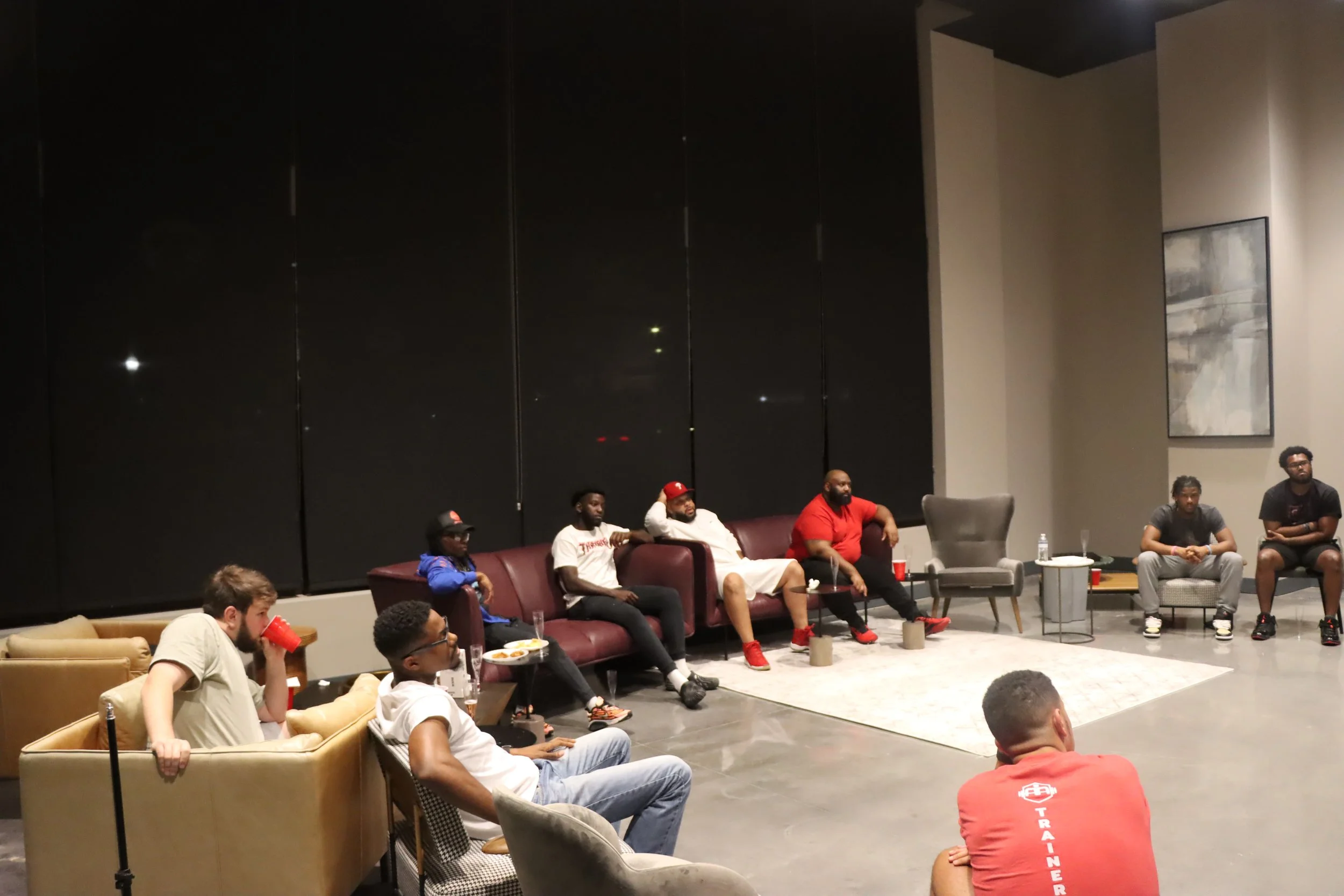
MOA archive photograph — an earlier gathering, not November 17.
By Christopher Thomas · Action Journal · Source: November 17, 2026
You stop hiding from the truth by letting God’s Word examine the explanation you keep defending, then taking one faithful step you can actually name. That may mean owning a wrong, asking for help, or admitting that your prediction of failure is not a fact. You do not have to manufacture certainty. You do have to become willing to hear something you did not plan to hear.
What if the explanation that makes your life understandable is also keeping it unchanged? You have reasons. Some are real limitations that deserve support. Others have become a way to protect a decision from examination. The work is learning to tell the difference without flattering yourself or condemning your whole life.
This study draws from teaching and discussion led by Christopher Thomas, Dustin Harper, Kenneth Washington, and Dante Giles. This article develops the teaching without reproducing participants’ private disclosures. It is an invitation to examine yourself honestly, with compassion and responsibility held together.
When an explanation becomes a hiding place
An explanation can help us understand a pattern. It can also protect that pattern from examination. The difference often becomes visible when someone offers information that does not fit our story.
Consider an ordinary example: you say you cannot keep a promise because you have no time. That may be accurate; you may need to renegotiate the promise. But if you repeatedly choose something less important while refusing to acknowledge the choice, “no time” has become an explanation that conceals responsibility. The issue is no longer only the schedule. It is whether you will tell the truth about it.
Tuesday’s challenge was not to force a public confession. It is to stop using community as another stage for the version of ourselves we want people to applaud. You can protect privacy while being truthful. You can say, “There is something I need help addressing,” without telling a room the details of someone else’s life.
Honesty is different from immediate certainty
Some questions need thought. Being hesitant does not establish that a person is deceptive, spiritually resistant, or unready for responsibility. People process differently. A truthful conversation should make room for that.
Likewise, naming a feeling does not make every conclusion attached to it true. “I feel rejected” communicates an experience. “Nobody will ever care” makes a much larger claim. Bring both into the light, but examine them differently. Truth can acknowledge pain while questioning the verdict pain has produced.
Do not turn an unknown future into a guaranteed failure
Christopher challenged the certainty that fear can borrow:
“If you don't know how to succeed, how do you know you're gonna fail?” — Christopher Thomas
The question is not a prediction that every attempt will succeed. It exposes a double standard: we admit that we lack knowledge, then speak about failure as though we have complete knowledge. “I need to learn” becomes “I cannot become.” Those are different claims, and they lead to different decisions.
You may need preparation before accepting a responsibility. You may also have access to instruction, support, or time that you have not included in your assessment. Ask what you can learn, who can help, and what a proportionate next step would be. Confidence does not require ignoring risk. It requires refusing to let an untested prediction have the authority of a settled fact.
An honest assessment can be hopeful and specific: I have not handled this well before. I need help with this part. Here is what I will practice differently. None of those statements promises an outcome. Each creates room for a response.
Matthew 6: prayer changes who directs the plan
Reading an excerpt from his prayer devotional, Christopher named the conflict:
“Some of us don't want God to lead. We want Him to approve.” — Christopher Thomas
Read Matthew 6:5–15. Jesus addresses prayer that seeks an audience and prayer that treats many words as a way to secure a hearing. He teaches His disciples to approach their Father, who knows their needs.
“Thy kingdom come, Thy will be done in earth, as it is in heaven.” — Matthew 6:10, KJV
This request comes before petitions for bread, forgiveness, and deliverance. The prayer welcomes ordinary needs while placing them within the Father’s authority. It forms a person who can ask sincerely and also surrender sincerely.
That challenges a familiar pattern: decide what we want, arrange the outcome, announce it, and finally ask God to lead. The words sound surrendered, but the decision has been protected from correction. The question is whether we will let God’s instruction alter the plan itself.
Take a decision you are making now. Does it require hiding information, neglecting a clear responsibility, or treating another person as a means to your preferred outcome? If so, calling it an answer to prayer does not settle the matter. Examine the choice before defending the label.
Dustin pressed the purpose of our praying:
“do we listen, or are we just praying to God to make our lives more pleasurable and more comfortable?” — Dustin Harper
The request for comfort is not itself the problem. Jesus teaches us to ask for bread and deliverance. The question is whether comfort has become the condition under which we are willing to listen. Can God’s Word challenge our conduct even before our circumstances become easier?
Listening involves more than waiting for a feeling that agrees with us. Christian discernment includes Scripture read in context, wise counsel, and willingness to be corrected. An internal impression should not be presented as unquestionable divine authority over another person. Prayer should make us more teachable.
John 20: Thomas’s conditions and Jesus’ invitation
The main Scripture discussed was John 20:24–31. Thomas was absent when Jesus appeared to the disciples. When they told him they had seen the Lord, he insisted on seeing the wounds and touching them before believing.
Eight days later, Jesus appeared among them, addressed Thomas’s stated conditions, and called him to believe. Thomas responded:
“And Thomas answered and said unto him, My Lord and my God.” — John 20:28, KJV
The movement is important. Thomas’s conditions do not remain the center; the identity of Jesus does. The passage then blesses those who believe without seeing Jesus, and John explains that the recorded signs support belief in Jesus as the Christ, the Son of God, and life through His name.
The group used a “Thomas test” as a reflection tool: what requirement have I placed on God before I will trust Him? That question can uncover resistance, but it must remain an application rather than a promise the passage does not make. Jesus’ mercy toward Thomas does not oblige God to reproduce every sign or outcome we demand. The text also does not explicitly say Thomas touched the wounds.
There is a difference between asking a genuine question and deciding that God cannot be trusted unless life follows your conditions. You can ask for help with doubt. You can study evidence and seek understanding. But if you already recognize a responsibility and refuse it until every uncomfortable possibility disappears, the condition itself needs examination.
Faith here is directed toward the risen Jesus. It is not confidence that our preferred future must happen. That distinction frees us to act responsibly without pretending we control the result.
The cost of responding does not buy grace
Tuesday’s discussion also confronted the desire for change without the discomfort that change can involve. A truthful apology may cost pride. Seeking guidance may cost the appearance of having everything together. Keeping a promise may require giving up a competing use of time.
God’s favor cannot be purchased by how much discomfort we endure. Some burdens require support, protection, treatment, or time. The useful question is narrower: what appropriate response is available to me, and what am I protecting by avoiding it? Answer about your own responsibility. Do not use the question to explain another person’s suffering from a distance.
Move from a true statement to a responsible response
At home, own the conduct instead of insisting it was out of character. You can say that a choice contradicts your values while still acknowledging that you made it. Listen to the effect before defending the intention.
For example: “I interrupted you and raised my voice. That was wrong. I want to hear what I dismissed.” That response names conduct and makes room for the other person. “I am just a terrible person” may sound more remorseful, but it can shift the conversation toward reassuring you while leaving the conduct untouched. These are illustrative examples, not participant accounts.
An apology is a beginning. Repair may require correcting information, completing a neglected responsibility, or changing the conditions that keep producing the same harm. Ask what is needed, then be honest about what you can commit to. Do not make a dramatic promise that becomes tomorrow’s new explanation.
In leadership, let someone tell you where your explanation is incomplete. Authority should increase your responsibility to hear truth. Do not make a person pay for noticing what needs attention.
In friendship, choose a trustworthy person who can listen without turning your disclosure into gossip or a spectacle. Ask for one concrete form of help. Healthy honesty does not require unlimited access, immediate disclosure, or ignoring a boundary. The aim is faithful response supported by truthful relationships.
The earlier study on awareness, acceptance, and alignment offers a useful foundation. This week adds a more specific examination: which explanation is keeping you from moving from awareness into action?
Three questions for private reflection
1. Recognition: Choose one decision you keep explaining. Which part is an observable fact, which part is a feeling, and which part is a prediction? What changes when you stop treating those three things as interchangeable?
2. Responsibility: What does your explanation protect—comfort, approval, control, or perhaps a legitimate boundary? What remains yours to address even if the situation is complicated? What is not yours to control?
3. Response: What would surrender change in the next seven days? What support do you need to act responsibly, and what guarantee have you been waiting for that nobody can give you?
Do not rush toward the most spiritual-sounding answer. A specific answer that can be examined is more useful than a polished one that closes the conversation. These questions are for your private reflection, not an interrogation of someone else. Sharing at the next gathering is optional; do not email sensitive disclosures.
A fifteen-minute practice with a visible next step
Within 48 hours, read Matthew 6:5–15 and John 20:24–31. Choose one decision and work through three short entries:
What I keep saying. Write the explanation in your own words. Name the feeling beneath it. Resist the urge to make either sound better.
What I actually know. Record one supporting fact and one challenging fact. Identify what Scripture requires in the situation. Separate a clear responsibility from an uncertain outcome.
My next faithful step. Choose one observable action within your control. Give it a time. Identify any help or boundary needed to make the action responsible.
A sample entry might read: “I keep saying I cannot have this conversation. I know I have postponed it twice, and I feel anxious about being misunderstood. I do not know how the other person will respond. Tomorrow at lunch I will ask for a suitable time to talk and prepare to listen.” This is an illustration, not a story from the group.
The action is deliberately small enough to complete. It could be correcting an inaccurate statement, requesting instruction, or completing a responsibility you have delayed. Choose one; do not convert reflection into a list of ten promises.
Afterward, record what you did and what it revealed. Success for this exercise means giving an accurate account of your response, not producing a comfortable feeling or a grateful reaction from someone else. If you did not follow through, identify the actual obstacle. Was the step unclear, too large, unsupported, or avoided? Adjust what needs adjusting and choose a new time. Do not use the missed step to declare yourself beyond growth.
At the next gathering, revisit: What changed? What resisted change? What is the next step? Share only what you choose. The purpose is to practice truth over time, with the support you need, rather than perform a breakthrough you cannot sustain.
Pray without performing
Father, I bring You my actual questions, motives, and choices. Help me stop defending an explanation that keeps me from Your truth. Through Jesus, teach me to trust You, receive correction, and act with care toward the people affected by my decisions. By Your Spirit, give me courage for the next faithful step. Amen.
Christopher Thomas is the founder of Men of Action in Huntsville, Alabama. This article develops the November 17 teaching and discussion with Dustin Harper, Kenneth Washington, and Dante Giles. Private participant stories are excluded.
Receive Action Notes through our existing newsletter signup. Explore more studies in the Action Journal.